Executive Voice Is a Design Problem, Not a Prompt Problem
/ Article
Most teams treat “executive voice” as a prompting problem. Write like this person. Sound more senior. Make it punchier.
That framing is wrong in a useful way.
Executive voice is a designed system of themes, structure, positioning, and prohibitions — applied per workflow, not a single prompt. Executive content is hard to automate because voice is not tone. It is recurring themes, vocabulary, sentence rhythm, positioning, and a list of things a leader will never say. It is also a product surface: different teams need different outputs from the same executive, and each output has different success criteria.
That matters beyond the drafting queue. When people and models cite leaders, attributed POV quality becomes part of how an organization shows up in search and answer surfaces — the same discoverability layer generative engine optimization teams care about. Weak executive content is not just a social problem; it is a discoverability and authority problem — the same clarity issue that shows up when structured data gets branded as “AI-powered” without defined systems underneath.
What this is / isn’t
- Is: a build story about voice profiles, workflow-specific prompting, and human review as reusable content-ops capabilities.
- Isn’t: a prompt cookbook, a model bake-off, or a pitch for publishing as an executive without a person in the loop.
I built a system to help marketing, communications, and content teams draft executive social content while keeping humans in control of publishing. The first version worked. Then people used it, and the interesting lesson was not about models. It was about discovering we had solved too small a problem.
The original problem was smaller than the real one
Leadership wanted to scale executive content across multiple leaders with distinct writing styles and limited bandwidth for manual drafting. The initial scope was social: generate promotional posts, preserve each executive’s voice, and keep publishing as a human decision.
That brief sounds clean. It is also incomplete.
“Generate executive posts” collapses several jobs into one:
- promote an existing asset
- produce a short attributed quote
- share an industry perspective that is not an article summary
Those jobs share a voice layer. They do not share the same prompt, inputs, or definition of good.
Voice is more than “write like X”
The reusable core was not the UI. It was a set of voice profiles.
Each profile captured how a leader actually writes and speaks, distilled from real source material rather than invented persona copy. The useful fields were concrete:
- voice and style (operator vs. keynote vs. analyst, for example)
- recurring themes and signature arguments
- preferred post structure (hook → observation → proof → implication → close)
- positioning and what “on-brand for this person” means in practice
- prohibited words and phrases (the soft corporate vocabulary that immediately breaks authenticity)
That last category mattered more than I expected. A model can imitate cadence. It is worse at knowing which words a specific executive finds empty. Encoding “never say this” is as important as encoding “sound like this.”
The profiles also became a briefing asset outside the app: attach one to a ghostwriting request, hand it to a new writer, or use it as onboarding documentation. The application was one consumer of the same capability.
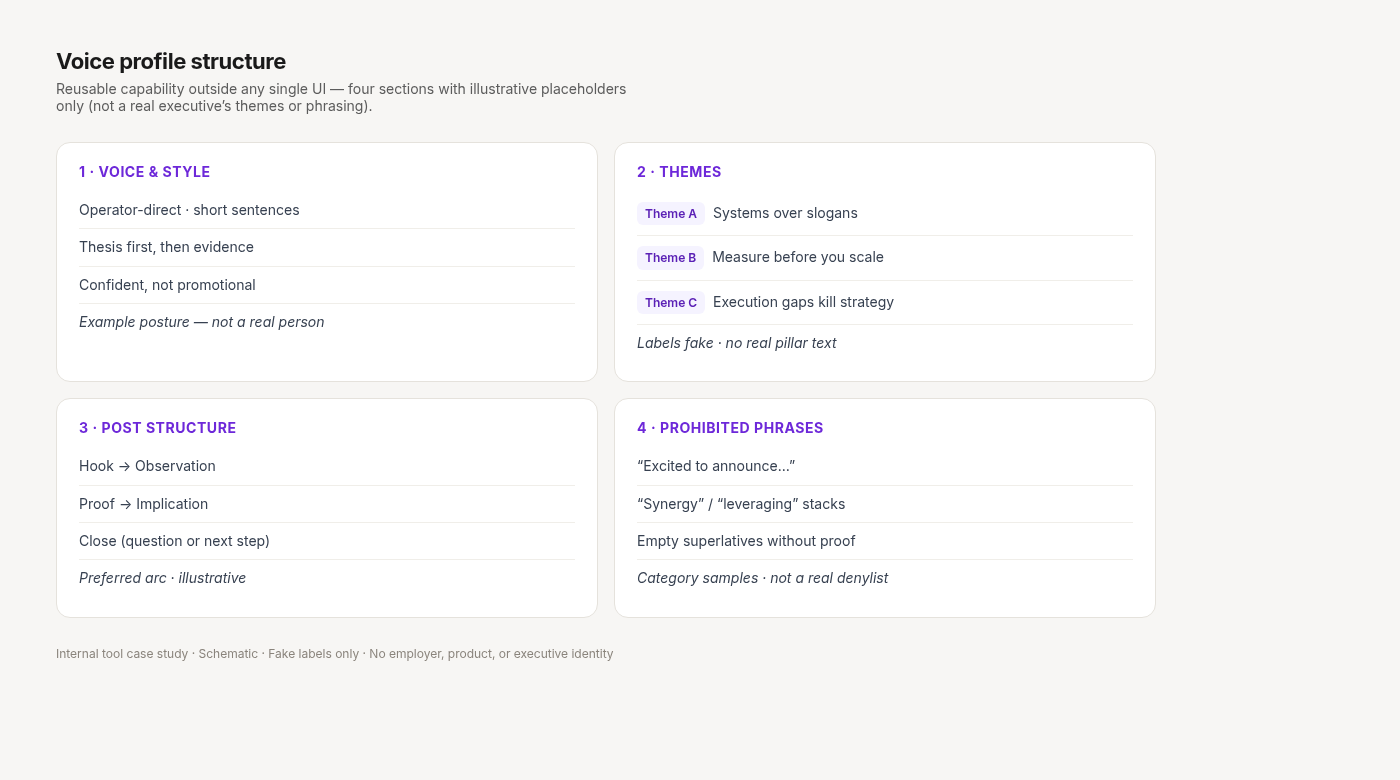
Figure: Voice profile structure (schematic). Fake labels only — not a real executive’s themes or phrasing.
The first version worked until people started using it
The initial release included a set of executive profiles, a promotional workflow, source-grounded drafting, and mandatory human review. It did what the brief asked.
Then feedback arrived, and it was not mostly about prose quality.
Stakeholders did not only need promotional posts. They needed different communication workflows with different goals:
| Workflow | Job to be done | What “good” looks like | | --- | --- | --- | | Promotional | Promote an article, announcement, campaign, or event | Multi-platform drafts grounded in the source, clear CTA, destination link, visual guidance | | Executive quote | Provide an attributed line for a partner blog, press release, or recap | One to three sentences in that executive’s voice — no hashtags, no platform variants | | Thought leadership | Share an industry perspective | LinkedIn-first POV grounded in messaging pillars; news as context, not the subject |
Same voice system. Different prompts. Different inputs. Different success criteria.
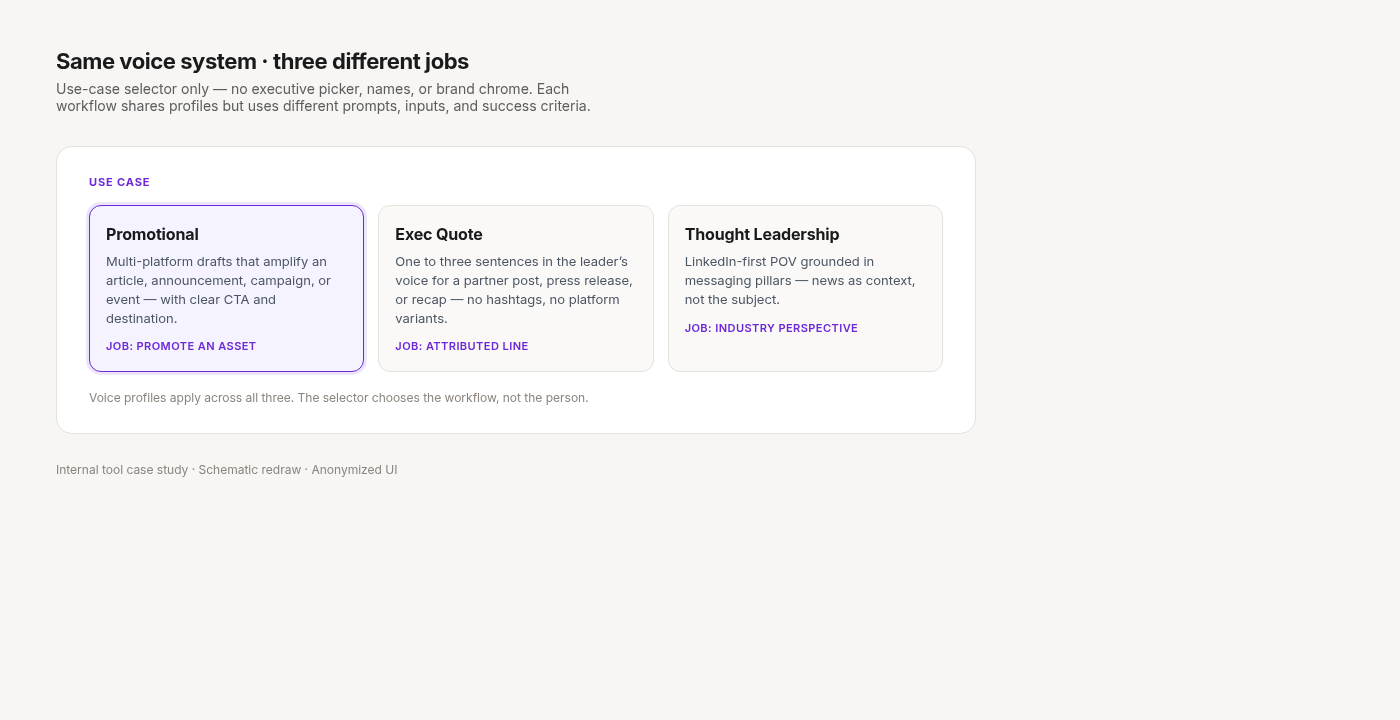
Figure: Use-case selector. Same voice profiles; different jobs, prompts, and success criteria.
That is the product lesson: the first ship solved a channel problem. Users needed a capability problem solved.
Expanding beyond one team
The biggest shift was organizational, not technical.
Originally the mental model was:
Social team → executive posts
It became:
Executive voice system → Social, Content, Communications
Once voice profiles and messaging guidance were durable assets, the UI stopped being the product. The product was the ability to apply an approved executive voice to the right workflow with the right guardrails.
That change also forced better workflow design. Thought leadership, for example, treats articles and news as inspiration for an executive point of view, not as material to summarize. Promotional treats the source as the subject and uses a separate destination URL for the call to action. Conflating those produces the generic “AI summary of a link” that nobody wants an executive to publish.
Designing for humans, not replacing them
Every output remained a draft. The system does not publish.
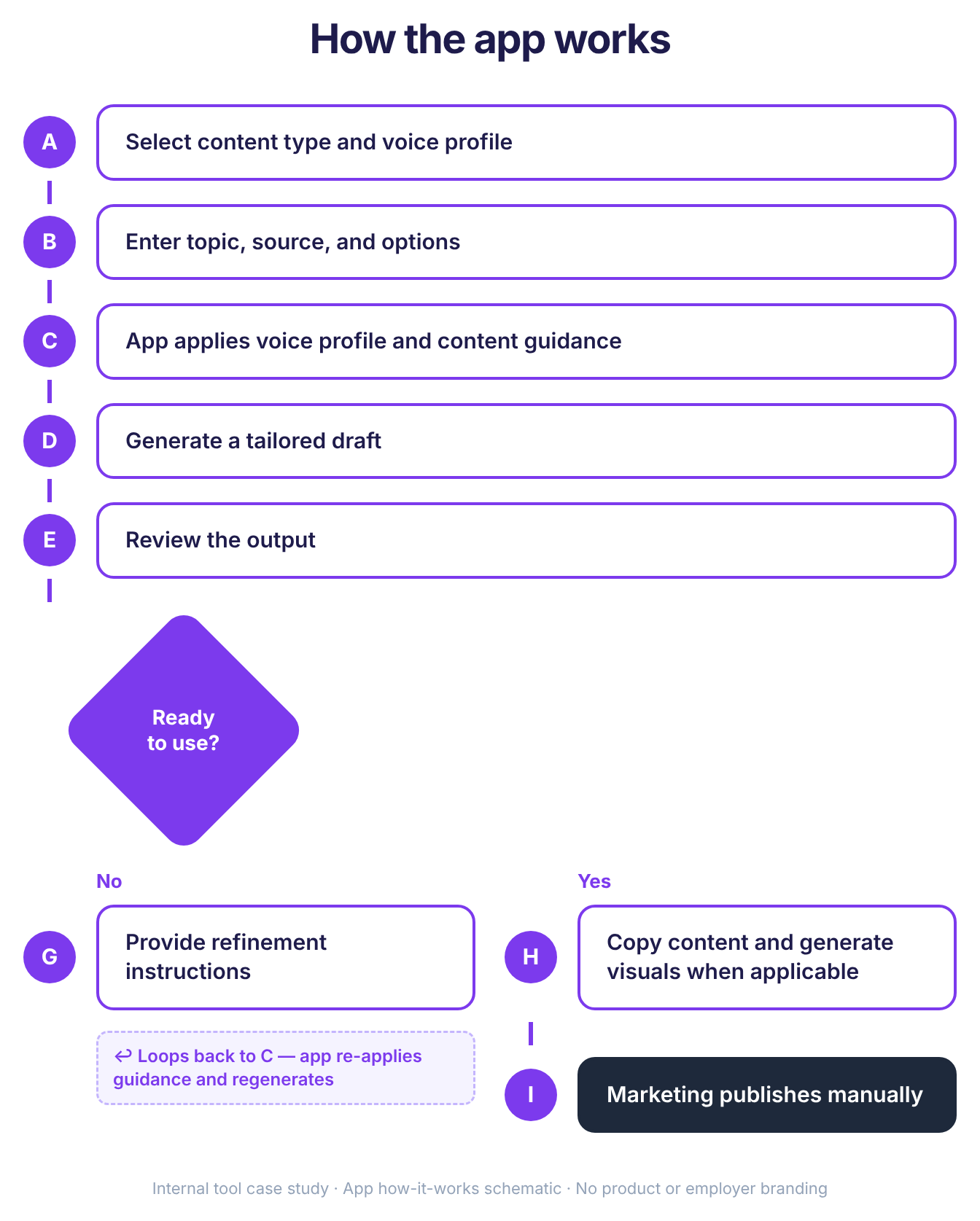
Figure: How the app works. Human review and a refine loop; marketing publishes manually — no auto-post.
Human review checked facts, links, quotes, executive voice, legal, brand, and communications requirements. That was not a political compromise. It was the only honest architecture for attributed leadership content.
Guardrails that mattered in practice:
- source-grounded generation where the job requires it
- destination-linked CTAs for promotional work
- messaging-pillar selection for thought leadership
- context-preserving refinement (revise what was asked, retain executive, workflow, and prior draft)
- explicit boundaries: profile quality, incomplete external pages, and unsupported assumptions still require a person
If a system can publish as an executive without a human in the loop, it is not a content system. It is a risk system.
Iteration over intelligence
The major releases tracked product learning more than model upgrades.
- V1: Establish the voice system and an initial promotional workflow.
- V2: Better grounding in supplied content, stronger CTAs, clearer errors, and in-session refinement that retained context across revisions.
- V3: Split into three workflows, add messaging pillars, treat news as context for POV, and improve the refinement loop.
Model quality mattered. Scope clarity mattered more. Most of the gains came from separating jobs, encoding voice constraints, and making refinement preserve the right state.
What changed my thinking
I stopped thinking “build an AI app” and started thinking “build reusable AI capabilities.”
The durable pieces were:
- voice profiles
- messaging pillars
- workflow-specific prompting
- refinement loops with retained context
- review and publishing boundaries
The application became one implementation of those capabilities. The point is the abstraction, not the shell — the same gap between strategy theater and operable systems I’ve written about in AI search strategy vs execution. That mattered when the next chapter arrived.
What happened after the app
Months later, the same executive voice system shipped as a reusable skill instead of only a standalone tool. The three workflows stayed: promotional, executive quote, and thought leadership. The profiles stayed. What changed was distribution and the improvement loop.
People could invoke the skill in ordinary drafting conversations, paste a source, and get a draft in a chosen executive voice. That made iteration cheaper than opening a separate app. It also created a new product boundary that had to be explained clearly: chat feedback does not permanently teach the skill. Anything said in one conversation only affects that conversation. Material that should stick for everyone — a strong recent post, a transcript, an interview, a marked-up edit — still has to be folded into the source profile through a deliberate update.
That boundary is easy to gloss over and important to name. “Just tell the model” feels like permanence. It is not. Durable voice quality still lives in the profile and the shared rules, not in ephemeral session memory.
The skill releases tracked the same kind of learning the app had:
- Calibrate profiles from real interviews and from draft-versus-approved finals, not from invented persona copy.
- Add shared writing rules across executives: strong hooks, point of view before the stat when that is the pattern, concrete proof instead of slogans, short single-idea paragraphs, and leave the call-to-action link alone.
- Treat “sounds robotic” as an engineering rule: vary sentence length, use contractions, avoid common AI tells, and run a self-check against those rules before showing a draft.
- Fix tone failures that looked like “too punchy” but were actually disconnected sentences and jumping into a correction without acknowledging the good news first — grounded in approved-versus-draft pairs, not guesswork.
- Move the skill into a reviewed repository so profile and rule updates land through the same discipline as other product work.
None of that required a new model breakthrough. It required treating voice as a maintained system: profiles, shared rules, self-checks, and a path for real source material to enter the source of truth.
Looking back
If I rebuilt this from scratch today, I would invest earlier in what the skill era eventually forced:
- structured feedback from reviewers (what changed before publish, and why), wired into profile and rule updates
- continuous profile updates as leaders’ public voices evolve
- clearer user education about what session feedback can and cannot change
- versioned, reviewed packaging so the capability can move from an app to a skill without forking the voice system
I would also keep resisting the urge to collapse every request into one “generate” button. The expensive mistake was not choosing the wrong model. It was shipping one workflow and calling the problem solved — and later, assuming a chat could permanently teach a skill without updating the profile.
Takeaways
- Executive voice is a design problem, not a prompt problem: themes, structure, positioning, and prohibitions — applied per workflow.
- The most valuable asset became the voice system, not the interface — which is why the same system could later ship as a skill.
- User feedback reshaped the product more than model improvements, including draft-versus-approved calibration and tone fixes grounded in real edits.
- Building for one team revealed a reusable abstraction that could support many — and that abstraction outlived the original app shell.
- Session memory is not a profile. Durable voice still needs a deliberate update path.